Support Frameworks Strengthening API Protections for Subscription Mobile Payments Under PCI Standards

Support frameworks operate as critical layers that reinforce API security measures within recurring mobile payment environments governed by PCI DSS requirements, and they achieve this by delivering continuous monitoring alongside rapid response protocols that address emerging vulnerabilities in transaction streams.
Core Elements of PCI Compliance in Mobile Recurring Systems
PCI DSS outlines twelve core requirements that organizations must satisfy to protect cardholder data during storage, processing, and transmission, while recurring mobile payments introduce additional complexities because subscription models generate repeated authorization requests through APIs that connect merchant platforms to payment gateways and banks. Data from industry reports shows that these APIs handle sensitive details such as tokenized card information and billing cycles, so support teams maintain encryption standards and access controls that align with requirement three and requirement seven of the PCI framework. Observers note that without dedicated assistance networks, developers risk overlooking subtle configuration drifts that could expose endpoints during high-volume subscription renewals.
API Architecture and Recurring Transaction Flows
Modern recurring payment APIs typically employ RESTful or GraphQL structures to manage authentication tokens, schedule billing events, and reconcile failed attempts, yet each call must comply with PCI rules around secure transmission and logging. Those who've studied these systems know that support personnel often implement rate limiting and anomaly detection scripts that flag unusual patterns, such as repeated authorization attempts from the same device in a short window, thereby preventing potential credential stuffing that targets subscription accounts. Research indicates that in May 2026 several updates to PCI DSS version 4.0 took effect, emphasizing stronger multi-factor requirements for API access keys used in automated billing loops.
Mechanisms Through Which Support Bolsters Security
Support systems contribute through structured incident escalation paths that allow security teams to isolate compromised API keys within minutes rather than hours, and this speed matters because mobile recurring payments operate across time zones with little downtime tolerance. Experts have observed that regular vulnerability scans coordinated by support staff catch outdated libraries in mobile SDKs before they become entry points for data interception, while training modules delivered to developer teams reinforce secure coding practices specific to PCI environments. What's interesting is how these networks also manage certificate renewals and key rotations, ensuring that encryption protocols remain current without disrupting subscription cycles that rely on seamless API handshakes.
Case examples reveal that organizations employing 24-hour support rotations reduced their mean time to respond to API-related alerts by integrating automated ticketing with real-time log analysis tools, and this integration helps satisfy PCI requirement ten around audit trails. Researchers discovered that when support frameworks include cross-functional collaboration between compliance officers and mobile engineers, the result is fewer misconfigurations in webhook endpoints that process recurring payment notifications.
Integration With Broader Compliance and Monitoring Tools
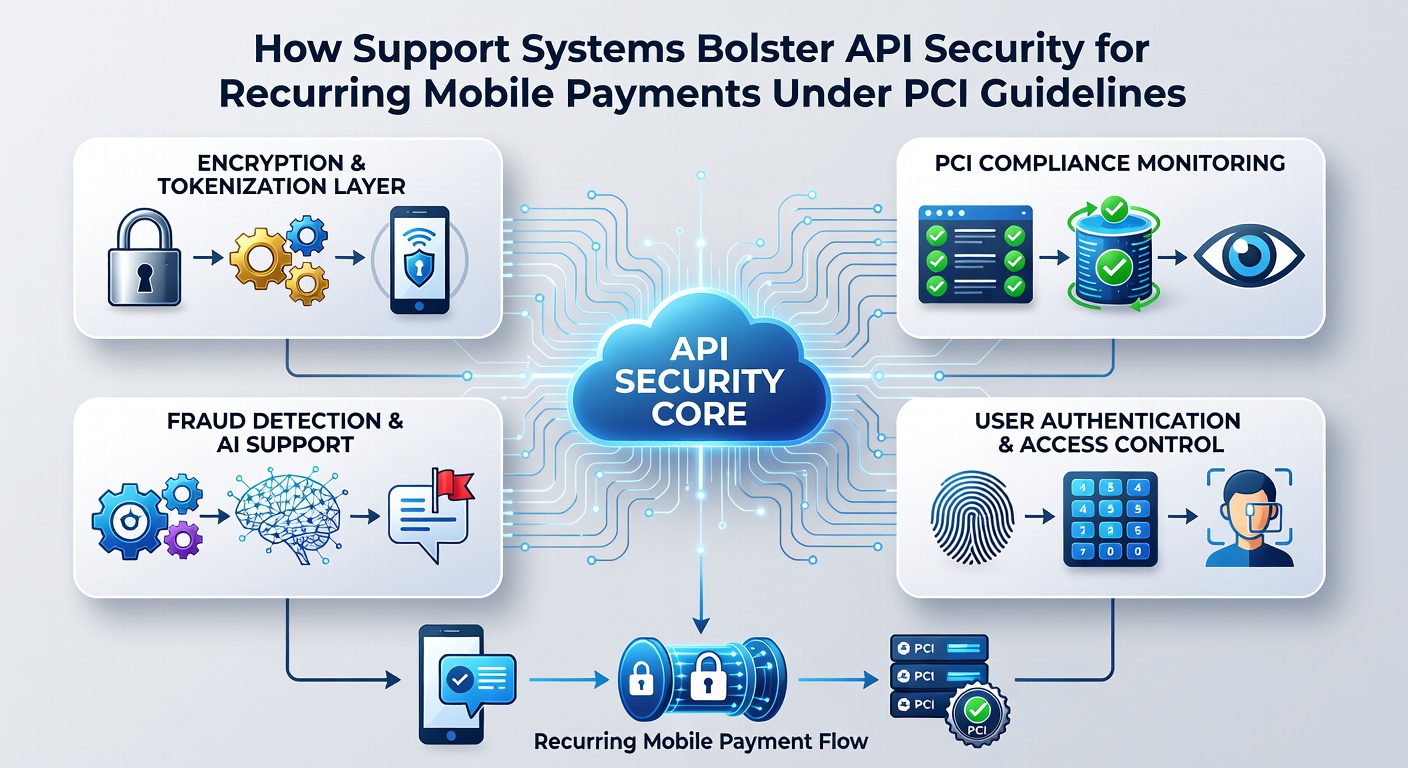
Support frameworks frequently interface with SIEM platforms and tokenization services to maintain continuous oversight of data flows in recurring mobile setups, and according to guidance from the PCI Security Standards Council such integration supports the validation of compensating controls when full segmentation proves challenging. Those who've examined payment ecosystems note that assistance teams also coordinate quarterly ASV scans and annual penetration tests focused on API surfaces, ensuring that findings translate into actionable patches rather than remaining as open tickets. Data shows that in regions following ENISA recommendations, similar support structures have helped align mobile payment APIs with both PCI and broader cybersecurity directives.
Challenges Addressed by Dedicated Assistance Networks
Recurring mobile payments face challenges such as device fingerprinting inconsistencies and token lifecycle management across app updates, yet support systems mitigate these through documented playbooks that guide teams during PCI-mandated change management processes. Studies found that proactive outreach from support personnel, including code review sessions and configuration audits, prevents the accumulation of technical debt that could otherwise weaken authentication mechanisms in subscription APIs. The reality is that without these human-centered layers, automated tools alone often miss contextual nuances that arise during peak billing periods like end-of-month cycles.
Conclusion
Support frameworks ultimately serve as the connective tissue that keeps API security measures aligned with evolving PCI guidelines in recurring mobile payment environments, delivering the operational continuity and expertise required to handle both routine maintenance and unexpected threats. As transaction volumes continue to grow through subscription models, the structured assistance provided by these networks remains essential for sustaining compliance and protecting cardholder information across global mobile ecosystems.